A closer look / LAUNCH
An expansion problem. A working system.
How I used AI-assisted discovery to turn geographic venue research into a reviewable operational workflow.
I was building LAUNCH, an in-person AI learning offer. Expansion raised a practical question: if we found an instructor in another city, how could we have meeting venues ready without repeating the research and data entry by hand?
Make discovery part of the operation.
I built a workflow in which an operator chooses geography, describes the kinds of places needed, and asks an AI provider to propose candidates. The results become structured records that can be reviewed, activated, and used by the wider operation.
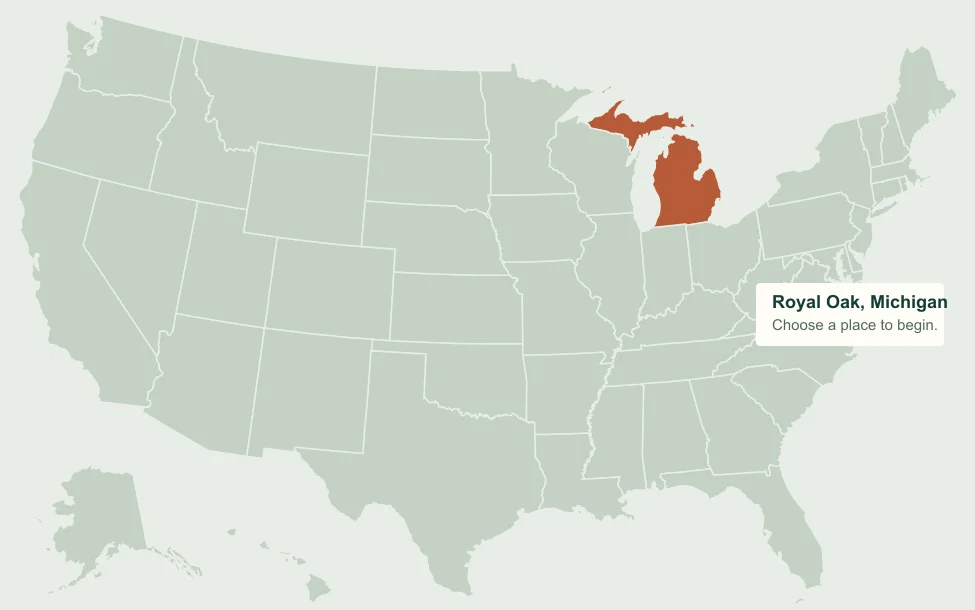
From a territory to usable inventory.
- Choose where. State maps, town and ZIP searches, individual selections, and saved regions describe the territory. Royal Oak, Michigan, is one example from my use of the system.
- Define what to find. Configurable venue types and versioned prompts describe the search. Provider adapters support OpenAI, Claude, and Gemini.
- Estimate and run. The operator can inspect the planned prompts and cost estimate, set a spending cap, and start or stop discovery. Run history preserves the work.
- Review the candidates. Discovered venues are saved inactive, with source and review information. A person checks the details before activation.
- Use what was built. Venue records connect to places and operating organizations. The larger application links venues to classes and registration workflows.
The decisions matter as much as the AI call.
A confident model response is not the same as a usable operating record. I wanted discovery to fit into a reviewable process.
- Keep suggestions separate from active inventory. A proposed place does not go live just because AI returned it.
- Keep history. Versioned prompts, run records, and source information make it possible to inspect what happened.
- Set operating limits. The implementation includes cost estimates, spending limits, duplicate handling, and stopping controls.
- Respect existing work. Withdrawal is designed to preserve records that a person has activated, edited, or used.
“A fact marked Sure means a source was cited, not that it is certainly true. Always look before activating.”
From the console’s operator manual. The review is part of the workflow.
A control room, not an isolated finder.
The console includes registration requests, venues, scheduled classes, people, places, instructor and student rosters, curricula, attendance, organizations, messages, discovery, and access management.
Its manuals give each station a mission, explain the controls and operating rules, and suggest something to try. That is part of making a system usable by someone besides the person who built it.
“A person is one human, recorded once, whatever they do with LAUNCH: a student, a payer, a leader, a guest.”
Another operator-manual example: separate the person from the roles they take on.
Territory belongs to the operation, too.
The application now represents access through territorial grants: a person can hold capabilities for particular regions, a state, or the whole United States. That connects geographic expansion to the question of who can work with which records. This describes the current implementation, not evidence of a national deployment.
A pattern that can be used elsewhere.
The common discovery engine is separated from the product’s finder definition, providers, data stores, and result-saving behavior. The operator sees a venue tool; underneath it is a pattern that could support other kinds of inventory.
A golf-course locator is one possible adaptation. That adaptation is an idea for reuse, not a second application already delivered.
What this case establishes.
The console and discovery implementation exist in my codebase. This account describes that implemented workflow and the decisions behind it. It does not claim nationwide operation, measured savings, or an independently established adoption result.
GPS lookup is a separate step from initial discovery. Public opening hours do not establish whether a venue is available to host a class. The application continues to develop, and live production behavior has not been independently acceptance-tested for this case.
Implementation basis
- Console station definitions and operator manuals.
- Discovery interface, geographic data, provider selection, prompt management, and review controls.
- Product-independent discovery interfaces and pipeline.
- LAUNCH-specific wiring and the venue-saving service.
Prepared from source inspection on October 20, 2026. No private operational records are displayed.